Eng
Eng
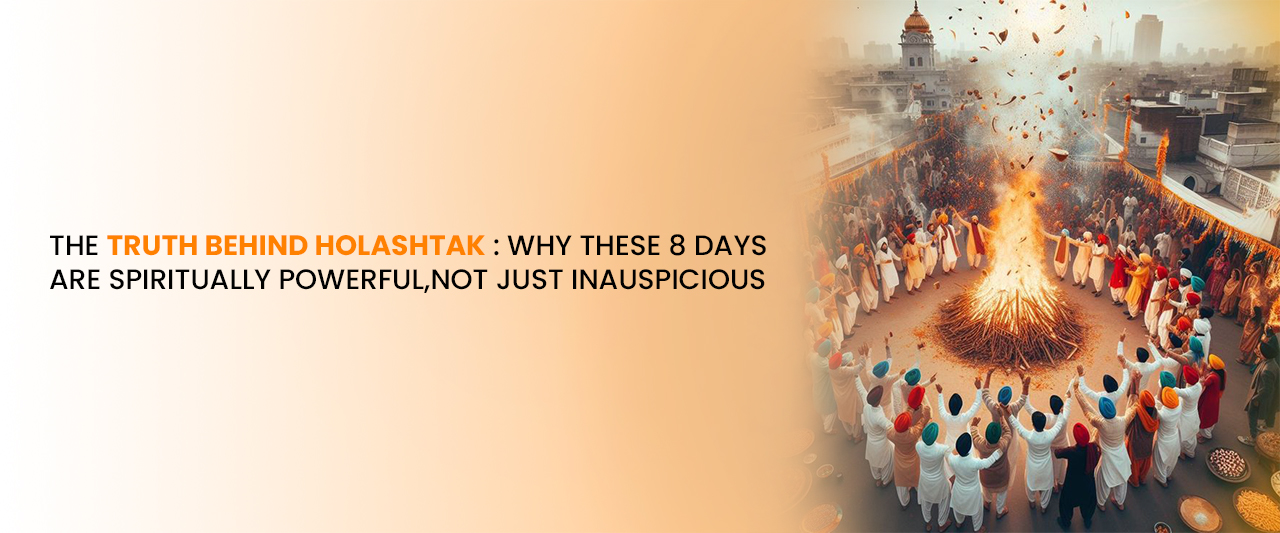
In Hindu astrology, the word Holashtak often creates fear and confusion. Many people believe these eight days before Holi are unlucky and avoid all auspicious work. Weddings, housewarming ceremonies, and new beginnings are usually postponed.
But is Holashtak truly inauspicious, or is there a deeper spiritual meaning behind it?
According to Vedic astrology, Holashtak is not about negativity—it is about intense cosmic transformation. These eight days carry powerful planetary energy meant for inner cleansing, reflection, and spiritual growth.
Let us uncover the real truth behind Holashtak and understand why ancient astrology considered this period spiritually significant rather than harmful.
Holashtak begins eight days before Holi, starting from Ashtami Tithi of Phalguna month and ends on the full moon day.
During this period, eight major planetary energies are believed to be highly active. These include the Sun, Moon, Mars, Mercury, Jupiter, Venus, Saturn, and Rahu. Their combined influence creates emotional sensitivity, mental unrest, and inner churning.
Vedic astrologers observed that this intense energy is not ideal for material celebrations but is perfect for spiritual practices.
Holashtak is believed to activate deep karmic cleansing. Emotions that remain suppressed often surface during these days. This is not a bad sign—it is the soul’s way of releasing old patterns.
This is why experienced practitioners of online astrology suggest focusing on self-awareness rather than external achievements during Holashtak.
The planets during Holashtak are not malefic, but their energies become intense. This intensity can cause confusion, impatience, or emotional imbalance if not handled mindfully.
Ancient sages advised avoiding major life decisions during this time because the mind may not be fully stable, not because the time is unlucky.
Holashtak is considered extremely powerful for:
Many top astrology services recommend spiritual remedies during this period because planetary energies respond faster to sincere prayers.
Weddings, griha pravesh, and business launches require stable and supportive planetary vibrations. Holashtak’s intense energy may disturb harmony, which is why such events are traditionally postponed.
However, this does not mean the days themselves are harmful. They are simply better suited for spiritual alignment rather than worldly celebrations.
Spiritually, Holashtak symbolizes the burning of negativity, ego, and karmic burdens—just like Holika Dahan represents the victory of devotion over arrogance.
This period prepares the soul for renewal, which is why Holi follows immediately after Holashtak ends.
Instead of fearing Holashtak, use it wisely:
This approach turns Holashtak into a healing phase rather than a stressful one.
Holashtak is not about bad luck—it is about deep spiritual energy. Vedic astrology never labeled these eight days as negative; instead, they were meant for pause, purification, and inner growth.
When understood correctly, Holashtak becomes a sacred window to realign your mind, karma, and spiritual path. By respecting its energy and following conscious practices, you can transform these days into a powerful stepping stone toward clarity and balance.
No. Holashtak is not inauspicious. It is a spiritually intense period where planetary energies are strong, making it unsuitable for material celebrations but ideal for inner work.
Major life events are usually avoided. However, spiritual practices, learning, and self-improvement activities are highly recommended.
Because emotional and planetary instability during this time may affect harmony. Vedic astrology prefers stable planetary periods for marriages.
Mantra chanting, fasting, charity, meditation, and consulting online astrology experts for personalized guidance are considered beneficial.
Yes. Holashtak is an excellent time to talk to astrologer online to understand karmic patterns and receive remedies aligned with your birth chart.