Eng
Eng
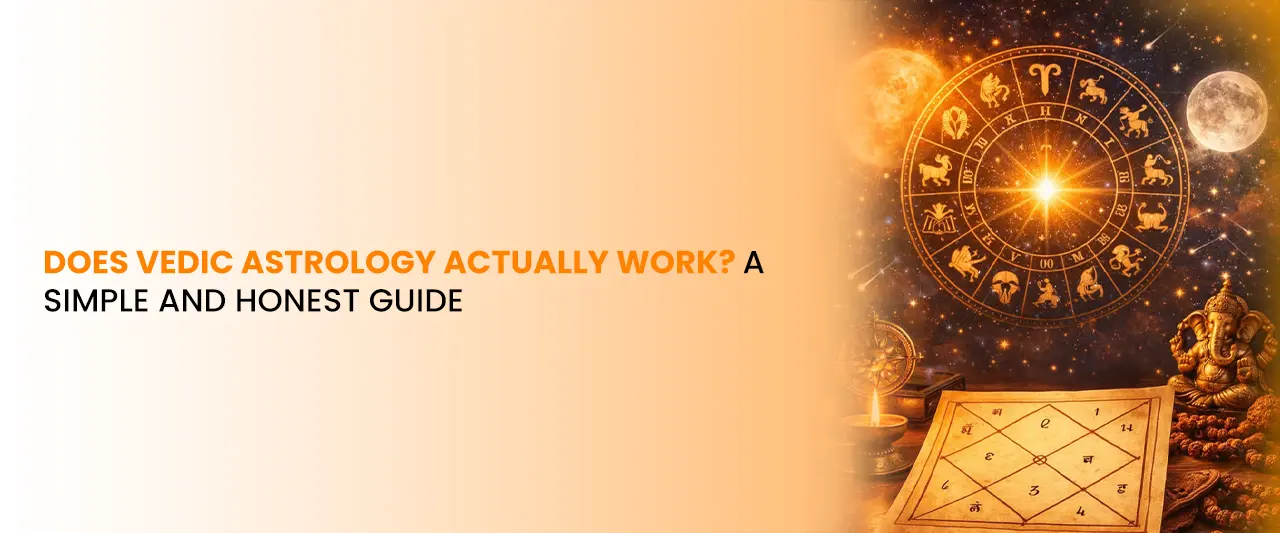
For thousands of years, people in India have turned to Vedic astrology for guidance about relationships, career, marriage, finances, health, and important life decisions. Even today, many individuals check their horoscope before starting a new job, getting married, buying property, or making major changes in life.
But one question still remains common: Does Vedic astrology actually work?
Some people strongly believe in it, while others consider it nothing more than superstition. The truth is more complex than a simple yes or no answer. To understand Vedic astrology properly, it is important to look at both its traditional roots and the psychological reasons behind its influence.
What Is Vedic Astrology?
Vedic astrology, also known as Jyotish Shastra, is an ancient Indian system of astrology based on planetary positions, birth charts, and lunar constellations. Unlike Western astrology, which mainly focuses on the Sun sign, Vedic astrology studies the Moon sign, planetary transits, houses, and karmic influences in much greater detail.
According to this system, the position of planets at the time of birth can influence a person’s personality, emotional tendencies, strengths, weaknesses, and life experiences.
Many people use Vedic astrology to gain clarity during confusing or difficult phases of life.
Why Do So Many People Believe in Vedic Astrology?
One major reason Vedic astrology remains popular is because it often feels deeply personal. A detailed birth chart can include insights about emotions, relationships, habits, fears, ambitions, and life patterns that many people strongly relate to.
For example, someone may feel surprised when an astrologer accurately describes their personality or current struggles without knowing much about them beforehand. This emotional connection makes astrology feel meaningful and believable.
In India especially, astrology is also connected with culture, family traditions, and spirituality. Many people grow up seeing parents or elders consult astrologers during important life events, which naturally increases trust in the system.
Can Astrology Scientifically Predict the Future?
This is where opinions become divided.
Scientifically, there is no strong evidence proving that planetary movements directly control human destiny or future events. Most modern scientists do not consider astrology a proven science because its predictions cannot always be tested consistently under scientific conditions.
However, this does not automatically mean astrology has no value at all.
Human psychology plays an important role here. Sometimes astrology works more as a tool for guidance, self-reflection, and emotional reassurance rather than exact prediction.
For instance, when people receive positive advice or hope through astrology, they may become more confident and motivated in real life. Similarly, astrology can encourage people to think more deeply about their actions, relationships, and decisions.
Why Astrology Sometimes Feels Accurate
There are several reasons why Vedic astrology may feel accurate to many individuals.
1. Deep Observation of Human Behavior
Experienced astrologers often spend years studying personality patterns, emotions, relationships, and life cycles. This understanding can help them give advice that feels surprisingly relevant.
2. The Barnum Effect
Psychology explains that people often relate strongly to general statements that apply to many individuals. This is known as the Barnum Effect.
For example:
These kinds of statements feel highly personal even though they are common human experiences.
3. Timing and Emotional State
People usually consult astrology during stressful or uncertain phases of life. During such moments, guidance and reassurance naturally feel more impactful and emotionally meaningful.
Can Vedic Astrology Be Helpful?
For many people, yes — but not always in the way they expect.
Astrology may not function like a guaranteed future prediction machine, but it can still offer:
Many individuals use astrology to understand their strengths, improve relationships, or feel mentally stronger during difficult times.
In this sense, astrology can sometimes act more like a guidance system than an exact science. You can contact vedic astrologers online to learn about astrology.
The Importance of Balance
It is important not to become completely dependent on astrology for every life decision. Major choices related to health, finances, education, or relationships should always involve practical thinking and personal responsibility.
Unfortunately, some people blindly follow predictions or become overly fearful because of negative astrological advice. This can create unnecessary anxiety.
A balanced approach is healthier. Astrology can be used as a supportive tool for reflection and guidance while still relying on logic, effort, and real-world decision-making.
So, Does Vedic Astrology Actually Work?
The answer depends on how a person defines “work.” If someone expects astrology to predict every future event with complete accuracy, they may feel disappointed. But if astrology is viewed as a system that provides emotional insight, self-awareness, guidance, and hope, many people genuinely find value in it.
Vedic astrology continues to survive after thousands of years because it fulfills something deeply human — the desire to understand life, reduce uncertainty, and find meaning during difficult times.
Whether someone fully believes in it or simply remains curious, astrology’s emotional and cultural influence is undeniable.
FAQs
1. Is Vedic astrology scientifically proven?
No, modern science has not fully proven Vedic astrology. However, many people still find emotional guidance and personal meaning through it.
2. Why does Vedic astrology feel accurate?
It often feels accurate because it combines personality analysis, emotional understanding, and psychological effects like the Barnum Effect.
3. Can astrology predict the future exactly?
Astrology cannot guarantee exact future predictions. It is generally better viewed as a guidance and self-reflection tool.
4. Why do people trust Vedic astrology so much in India?
Vedic astrology is deeply connected with Indian culture, traditions, spirituality, and family practices, which increases people’s trust in it.
5. Should people completely depend on astrology?
No. Astrology can offer support and guidance, but important life decisions should also involve practical thinking and personal judgment.